
Data seen during learning-rate decay has an outsized impact on the final model
OLMo 2, Marin, Llama 3 and Databricks all report large, task-specific gains from changing the data mix during the learning-rate decay. The evidence for that is strong. The stronger claim, that a token counts for more in decay than on the plateau, has not been tested directly.
OLMo 2 and Marin both show that changing the data mix during learning-rate decay can produce large, task-specific gains. OLMo 2 gives the clearest number. From the same 7B checkpoint, two 50B-token anneals scored 27 and 52 on the same math evaluation, depending on the mix. The stronger claim, that a token has more influence during decay than on the plateau, is not as well established. The published gains mix three effects: a falling learning rate, the data coming last, and a mix aimed at the evaluation. No study we know of separates them.
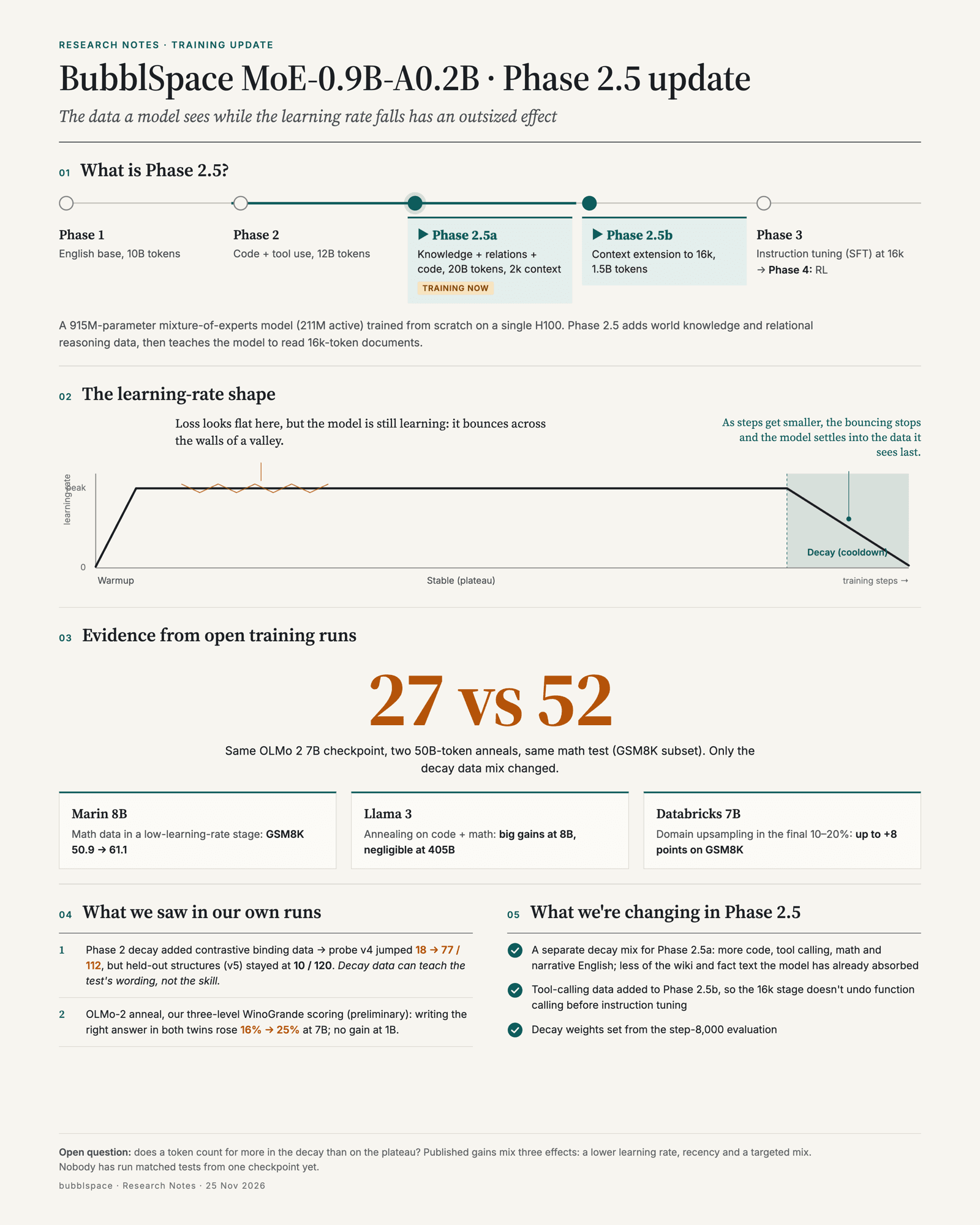
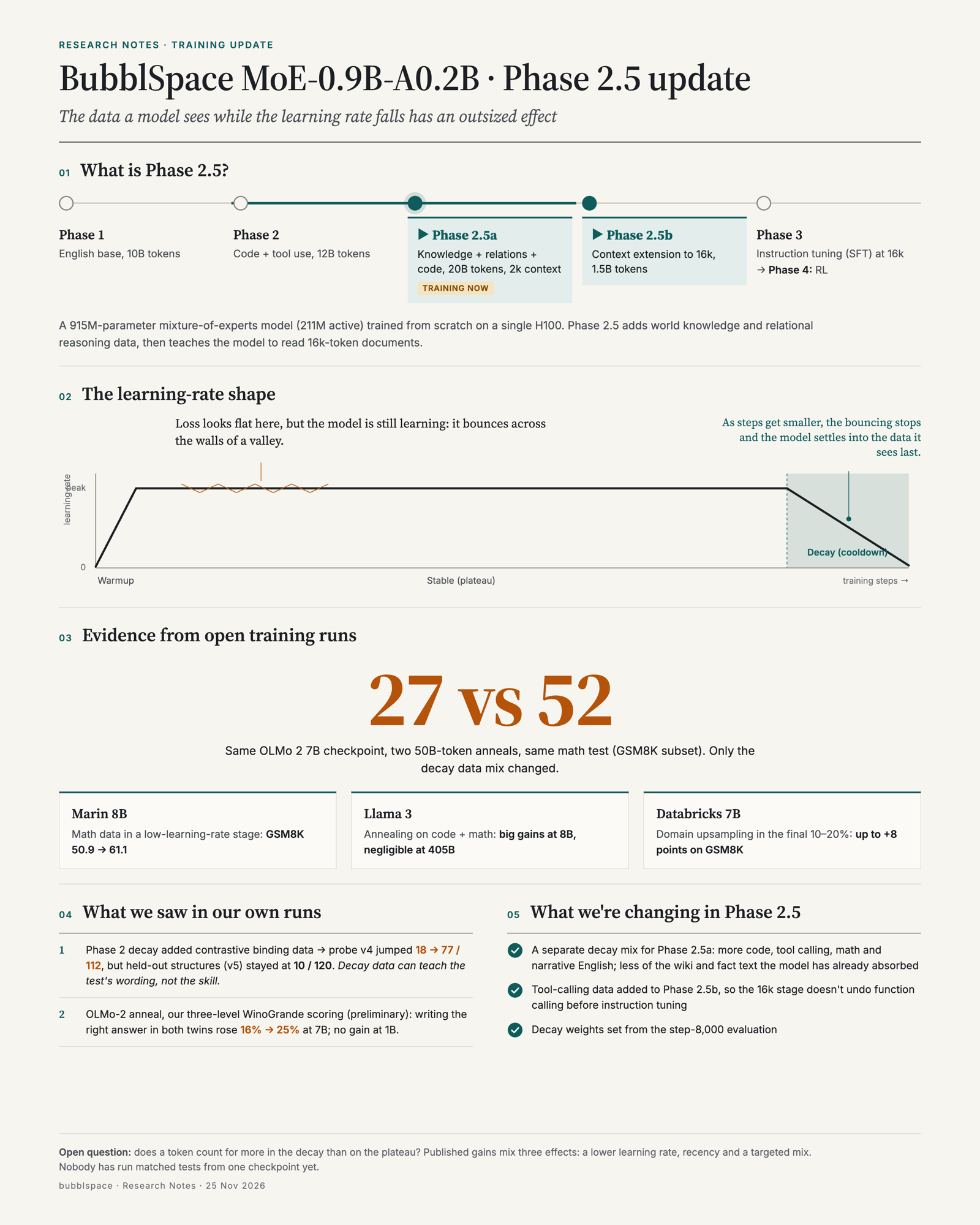
Evidence from open training runs
| Run | What changed in the decay | Result |
|---|---|---|
| OLMo 2 · 7B | Two 50B-token anneals from the same 4T-token checkpoint: the pretraining mix, and high-quality web plus math | GSM* (a 200-question GSM8K development subset): 27.0 with the pretraining mix, 52.0 with web plus math. GSM8K for the final 7B model went from 24.1 before mid-training to 67.5 after it (an average of three 50B-token anneals). |
| Marin · 8B | “Dessert” runs at a low learning rate that added synthetic math and FLAN | GSM8K 50.9 → 61.1 and MATH 18.4 → 21.1. FLAN left 5-shot MMLU flat (65.3 → 65.1). In short anneals, oversampling “high-quality” data alone didn’t help. The best mix was 70% pretraining, 15% FLAN and 15% high-quality data. |
| Llama 3 | Annealing on small amounts of high-quality code and math | 8B: GSM8K +24.0%, MATH +6.4%. 405B: “negligible” gains. Meta also uses short anneals of a half-trained 8B model to judge new datasets: 40B tokens with 30% weight on the new data. |
| Databricks · 7B, 1T tokens | Domain-specific sets upsampled relative to Common Crawl over the final part of training | Up to +6.90 points on MMLU, +8.26 on GSM8K and +6.17 on HumanEval. Upsampling over the final 10–20% of training balanced the targeted gains against general language modelling. |
- OLMo 2 report, §4.3 Table 11: 27 vs 52 from one checkpoint (50B-token anneals)
- OLMo 2 report, §4.2 Table 9: GSM8K 24.1 → 67.5 after mid-training
- OLMo 2 report, §4.1 Table 8: learning rate during the anneal
- OLMo 2 mid-training data (Dolmino mix)
- OLMo 2 7B checkpoints, incl. anneal branches (stage2-ingredient*)
- Marin 8B retrospective: Jellyfish and Starling cooldowns, Dessert runs, microannealing
- Marin 8B: Phoenix (rewarm after a cooldown, with a data switch)
- Marin 32B retrospective: Bison cooldown with a new mixture
- The Llama 3 Herd of Models (§3.1.3, §3.4.3)
- Blakeney et al., Does your data spark joy?
- Qwen3 technical report (pre-training stages)
- GLM-4.5 technical report (pre-training and mid-training)
- DeepSeek-V3 technical report (§4.2 schedule)
Why decay data sticks
One useful picture is a long valley with steep walls and a gently sloping floor. At a constant high learning rate, the model makes real progress along the floor, but each update overshoots across the walls, so the loss stays above the floor. As the learning rate decays, the bouncing stops and the loss drops quickly. Much of that drop is progress made on the plateau that was hidden until then. Because the final steps are small and nothing comes after them, the model settles into whatever data it sees at the end.
What the evidence doesn’t show yet
- Each-token influence. We know of no experiment that places the same tokens on the plateau and then in the decay, with everything else held fixed. The gains above could come from recency, from the low learning rate, or from the targeted mix.
- Scale. Gains shrink as models get larger but don’t disappear in the open reports: OLMo 2’s mid-training raised GSM8K by 43.4 points at 7B, 37.8 at 13B and 22.6 at 32B (24.1 → 67.5, 37.3 → 75.1, 56.2 → 78.8). Larger models start higher, so they have less room to gain. Marin’s 32B ended at GSM8K 54.7 and 69.1, and HumanEval 29.3 and 42.7, after two different cooldown mixes, though the comparison is confounded by a contamination fix and a shuffle change. Only Llama 3 reports “negligible” annealing gains, at 405B on GSM8K and MATH, and Meta still annealed the 405B model on high-quality data.
- Frontier MoE reports describe what they did but don’t measure it. Qwen3 adds ≈5T tokens with more STEM, code, reasoning and synthetic data and “accelerate[s] the learning rate decay during this stage.” GLM-4.5 adds repo-level code, synthetic reasoning and agent trajectories in mid-training while its cosine schedule decays. DeepSeek-V3 decays its learning rate in stages but reports no change to its data mix. None of the three publishes an ablation.
- Costs. In Marin’s first cooldown, loss on general web text (Paloma c4en) rose under a mix heavy in high-quality web data. Databricks found that upsampling for too long traded off general language modelling.
- Benchmark resemblance. A decay mix aimed at an evaluation can raise the score on that evaluation more than the underlying skill. See our own Phase 2 example below.
What we saw in our own runs
| Observation | Before the decay | After the decay | How to read it |
|---|---|---|---|
| Phase 2 anneal: binding probe v4 (contrastive v2 added at 6% in the decay only) | 18/112 (local step 17k) | 77/112 (final) | Probe v5 uses sentence structures held out of our data, and it stayed at 10/120. Most of the v4 jump is familiarity with the v2 phrasing, not general binding. |
| Phase 2 anneal: English six-task average | 46.18 (local step 17k) | 46.92 (final) | Partial recovery, with FineWeb-Edu kept in the decay mix at about 5.7% |
| OLMo-2 anneal, our three-level WinoGrande scoring (our measurement, preliminary) | 7B: both twins written correctly 16%, both ranked correctly 50% | 7B: written 25%, ranked 51% | The anneal turned an existing ranking ability into the ability to write the answer. At 1B there was no gain (4% → 3%). |
What we’re changing in Phase 2.5a
Phase 2.5a, our 20B-token knowledge phase, launched with one data mix for both the plateau and the decay. During the plateau, validation loss on the new knowledge data fell quickly and then flattened. Code, FIM and narrative English (LAMBADA, HellaSwag) drifted down. Before the decay starts at step 32,424, we plan to resume from a checkpoint with a separate decay mix. It shifts weight toward code, tool-calling data, math and narrative English, and away from the wiki and fact-seeking text the model has already absorbed. The exact weights depend on the step-8,000 evaluation. Separately, Phase 2.5b, the 16k-context stage, now includes tool-calling data at 5%, so its own re-warm and decay don’t undo function calling before SFT.